When agents write the code, you don't throw out continuous integration and delivery — you lean on it harder. CI/CD is exactly the discipline that lets you accept fast, autonomous changes without fast, autonomous breakage. Here's what it looks like with an agent as the author.
CI/CD meets agents
The pipeline shape is familiar: integrate continuously, deliver continuously, with checks between steps. What changes is the author — an agent, not a person — which makes the automated gates more important, not less. They're what keeps autonomy from becoming recklessness.
A gate at every stage
Each change passes a verify gate — your build and tests — before it merges. Failures auto-retry and, if they persist, route to review. By the time a change is eligible to ship, it has already cleared the mechanical bar, every time, without you watching.
Preview before promote
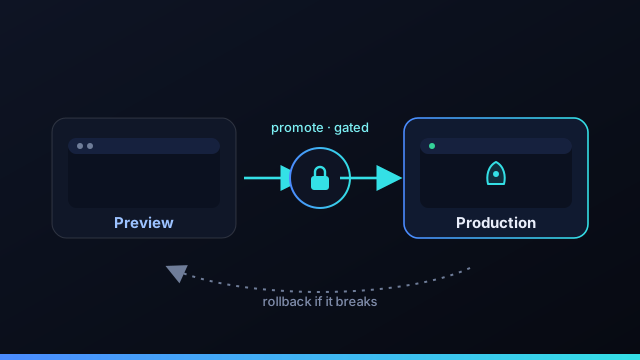
Before anything reaches production, it runs in a preview environment you can actually open and inspect. Crucially, preview and deploy share one manifest, so the preview isn't an approximation — it's the same build that will ship. Promotion is just blessing what you already saw.
If preview and production are built from different configs, your preview is a guess. Share the manifest and the preview becomes a promise.
Credential-gated deploys
Delivery waits for credentials. The pipeline won't fire a deploy until every required secret is in place, and those secrets live in a per-project vault the agents never see. A deploy can't half-complete with a missing key, and the code's author never holds production access.
Rollbacks
Because each release is a discrete promotion from a known-good preview, undoing one is straightforward: redeploy the previous version. There's no reconstructing a bespoke deploy from memory — the repeatability that makes shipping safe is the same repeatability that makes rolling back easy.
Fast, autonomous authors are safe only behind gates, previews, and a rollback button. CI/CD is how agents earn their autonomy.
The stages of an agent CI/CD pipeline
A CI/CD pipeline for AI coding agents has the same stages as any other, with the agent as the author. Build: a finished task compiles or bundles in its isolated worktree. Verify: the build-and-test gate runs automatically, with failures auto-retried and persistent ones routed to review. Review: a human reads the diff and approves. Integrate: the passing branch merges into the base in dependency order, so each change builds on integrated work. Preview: the change runs in a preview environment built from the same manifest as production. Promote: a credential-gated deploy ships it. Roll back if needed: redeploy the previous known-good version. The agent moves the work through the early stages fast; the gates keep the later ones safe.
The safety gates that matter most
When the author is autonomous, the gates are what keep speed from becoming recklessness — and three matter most. The verify gate ensures nothing merges unless it builds and passes tests, so broken code never advances. The review gate ensures a human approves intent before anything ships, so a change that builds but is wrong gets caught. And credential gating ensures a deploy never fires with a missing secret and that the agents writing code never hold production keys. Together they mean an agent can move fast through build and integration while every irreversible step — merging to main, deploying to production — still requires a green check and your sign-off. Fast, autonomous authors are safe only behind gates, previews, and a rollback button.
CI/CD for AI agents on a team
On a team, the win is consistency: every agent's change goes through the same pipeline, so it doesn't matter whether a human or an AI coding agent wrote it — the bar to ship is identical. Standardize the verify gate (the build and test command), require review before merge, integrate through a merge queue in dependency order to avoid conflicts, and keep deploy credentials in a per-project vault supplied per run. Because preview and deploy share one manifest, anyone can open a preview to inspect a change before it's promoted, and rolling back is the same repeatable step for everyone. Command Fleet bundles this pipeline — gate, review queue, dependency-ordered merges, credential-gated deploys — into one local-first app, so a small team gets CI/CD discipline for agent work without standing up their own infrastructure.
A CI/CD readiness checklist for AI agents
Before you let autonomous AI coding agents ship through your pipeline, make sure each safeguard is in place:
- A verify gate on every change — build and tests run automatically, with failures auto-retried and persistent ones routed to review.
- Human review before merge — a person approves intent, not just a green build.
- Dependency-ordered integration — a merge queue so each change builds on integrated work and conflicts route to review.
- One manifest for preview and deploy — so what you previewed is exactly what ships.
- Credential-gated deploys — the pipeline waits for required secrets, and agents never hold production keys.
- A clear rollback — each release is a repeatable promotion you can reverse by redeploying the previous version.
Tick all six and an autonomous author is safe to move fast, because every irreversible step still requires a green check and your sign-off. Command Fleet bundles this entire pipeline — gate, review queue, dependency-ordered merges, and credential-gated deploys — into one local-first app, so you get CI/CD discipline for agent work without assembling it yourself.
Frequently asked questions
What does CI/CD look like for AI agents?
The same shape as any CI/CD, with the agent as the author: a verify gate (build and tests) on every change, a preview environment to inspect, a credential-gated promotion to production, and a rollback path. The agent writes; the pipeline integrates and ships.
How do preview and production stay in sync?
They share a single preview/deploy manifest, so the build command, output, and routing are identical. What you previewed is what gets promoted — no separate, drift-prone production config.
How are deploy credentials protected?
Deploys are gated until every required credential is present, and credentials live in a per-project secrets vault that's never included in a prompt. The deploy step reads them directly; the agents that wrote the code never see them.
What if a deploy breaks production?
Because promotion is a discrete, repeatable step from a known-good preview, rolling back is a matter of redeploying the previous version — not reconstructing a one-off deploy from memory.
Ship agent work, safely
Command Fleet gates every change, shares one manifest for preview and deploy, and waits for credentials. Free for 7 days, no credit card.