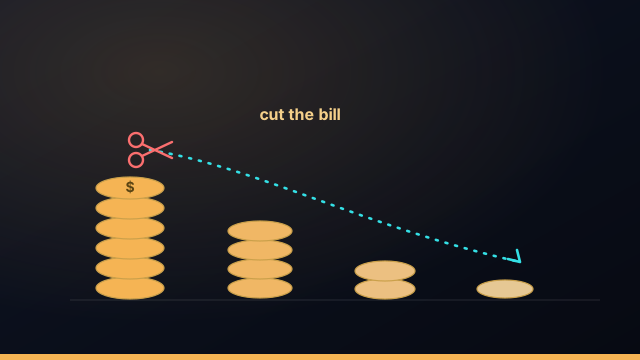
AI coding bills creep up quietly: a strong model on every task, sprawling prompts, retries you didn't notice. The fixes aren't painful — they're mostly good engineering habits that also happen to cost less. Here are nine that move the number, none of which slow you down.
Where the money goes
Three things dominate the bill: the strength of the model you pick, the size of the context each task drags along, and the number of retries a vague task triggers. Every tactic below targets one of those three.
Route by task
The biggest lever, by far. Dependency bumps, copy changes, and test scaffolding can go to a cheaper agent; save your strongest model for the gnarly refactor. Choosing the agent per task means you pay for power only where power earns its keep.
Cap concurrency to your budget
Parallelism is great for throughput, but unbounded parallelism is great for surprise bills. Set a concurrency cap that matches what you're willing to spend in a window, not what your machine can technically launch.
Scope tasks small
Small tasks carry less context, fail more cheaply, and need fewer retries. A focused "add a coupon field" costs a fraction of "overhaul checkout," because the agent isn't re-reasoning about half the codebase on every step.
A sprawling task pays for context twice — once to read it, again every time the agent re-orients. Small tasks just pay once.
Bring your own subscription
Pay the model provider directly instead of a tool that resells access with a markup on every run. For steady use, removing that middle margin is pure, recurring savings.
Measure per feature
Optimize the right number. Cost per token flatters the wrong choices; cost per shipped feature reflects reality, because your time is the expensive input. A setup that ships more per dollar of model spend is cheaper even if it burns more tokens.
The nine-point checklist
- Route cheap models to routine work.
- Reserve strong models for hard tasks.
- Scope every task small.
- Cap concurrency to your budget.
- Write acceptance criteria to cut retries.
- Point at files instead of pasting big blobs.
- Re-dispatch instead of arguing in a long thread.
- Bring your own subscription — no markup.
- Track cost per shipped feature.
You rarely cut an AI bill by trying to. You cut it by writing tighter tasks and routing them well.
How to measure what you're actually spending
You can't reduce a cost you don't measure, and the usual metric — tokens or dollars per run — flatters the wrong choices. The number that matters is cost per shipped feature: total model spend divided by the units of value you actually merged. Tracked that way, a setup that uses more tokens but ships more per dollar is winning, because your own time is the expensive input. Watch a couple of supporting signals too: your retry rate (high retries mean vague tasks burning tokens on guesses) and your average task size (sprawling tasks re-read context on every step). When cost creeps, it's almost always one of those two — not the headline model price — so measuring them tells you exactly which lever to pull.
Cutting cost without cutting quality
The fear with cost-cutting is that you'll ship worse code by reaching for cheaper models. Done right, you won't — because the savings come from matching power to difficulty, not from blanket downgrading. Boilerplate, copy tweaks, dependency bumps, and test scaffolding don't need your strongest model; a cheaper, faster one ships them at identical quality. You reserve the most capable agent for the genuinely hard work — the multi-file refactor, the subtle bug — where its extra capability actually changes the outcome. The other savings (tight tasks with clear acceptance criteria, small scope, bring-your-own to drop the markup) reduce wasted spend, not useful spend. Quality stays where it counts; you just stop paying premium prices for routine work.
Cutting AI coding costs across a team
On a team, the levers are the same but the discipline has to be shared. Agree on routing conventions — which kinds of tasks go to cheaper models — so everyone optimizes the same way. Standardize on bring-your-own subscriptions to avoid a per-seat tool markup stacking up across the team. Cap concurrency to a team budget rather than letting every member launch unlimited parallel agents. And review cost per shipped feature as a team metric, not just a personal one. Tools that support per-task agent choice, concurrency caps, and bring-your-own — like Command Fleet — make these habits enforceable by default, so the team's AI coding bill stays predictable even as the number of agents and projects grows.
The one-line summary
If you want the whole strategy in a sentence: you don't cut an AI coding bill by trying to spend less, you cut it by writing tighter tasks, routing them to the right-sized model, and paying the provider directly. Everything in this guide is a variation on that. Vague tasks burn tokens on retries, so write clear acceptance criteria. Sprawling tasks re-read context on every step, so scope them small. Using your strongest model for boilerplate overpays, so route cheap models to routine work. A bundled tool adds a markup to every run, so bring your own subscription. And optimizing tokens instead of shipped features measures the wrong thing, so track cost per shipped feature. Do those, cap concurrency to your budget, and the bill becomes predictable without anyone feeling like they're rationing. Command Fleet gives you the levers — per-task agent choice, a concurrency cap, and bring-your-own with no markup — so cost control is just how you already work.
Frequently asked questions
How do I reduce AI coding agent costs?
Route cheaper models to routine work and reserve strong ones for hard tasks, scope tasks small, cap concurrency to your budget, bring your own subscription to avoid markups, and measure cost per shipped feature so you optimize the number that matters.
Does using a cheaper model hurt quality?
Not when you match the model to the task. Boilerplate, copy tweaks, and test scaffolding don't need your strongest model; saving it for the genuinely hard work gives you the same quality where it counts at a lower total cost.
How does scoping tasks small save money?
Small tasks use less context, fail more cheaply, and need fewer retries. A focused task gets the job done in fewer tokens than a sprawling one that the agent has to re-reason about.
What's the best metric for AI coding cost?
Cost per shipped feature, not cost per token. Your own time is the expensive input; a setup that ships more per dollar of model spend is winning even if the token count looks higher.
Ship more per dollar
Command Fleet lets you route per task, cap concurrency, and bring your own subscription — no markup. Free for 7 days, no credit card.