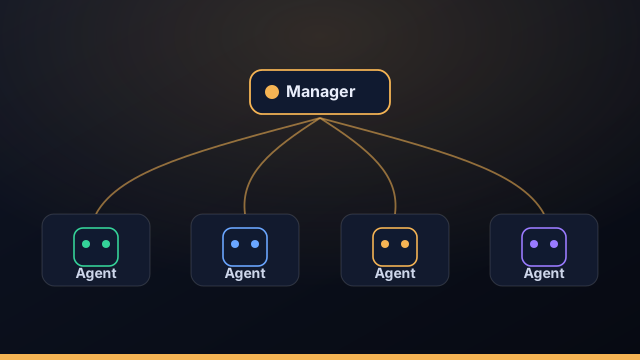
One agent working through a big job step by step is the slow path. Multi-agent orchestration is the fast one: a manager breaks the work apart, hands pieces to several agents at once, and stitches the results back together. Here's what that actually involves.
What orchestration means
Orchestration is coordination. Instead of one agent holding an entire project in its head, a manager plans the work, dispatches tasks, watches them run, and integrates what comes back. The agents stay focused on individual tasks; the manager owns the big picture.
Why one agent isn't enough
A single agent doing everything in sequence has three problems: it's slow (no parallelism), it's fragile (one long context that drifts), and it can't play to different models' strengths. Splitting the work across agents fixes all three — independent tasks run at once, each in a fresh context, each on the agent best suited to it.
The conductor pattern
Think of the manager as a conductor. It reads the goal, decides the order, and cues each player — but it doesn't play the instruments. In practice that means turning "build me X" into a set of tasks, choosing an agent for each, and starting the ones that are ready.
The agents are the musicians; the orchestrator is the conductor. You're the composer who approves the final score.
Isolation and scheduling
Parallelism is only safe with isolation. Each task runs in its own git worktree on its own branch, so agents never share a working directory. A scheduler launches tasks whose dependencies are satisfied, up to a safe concurrency cap, and holds the rest until their prerequisites finish.
Review and merge
Finished work doesn't merge itself blindly. A passing branch is integrated in dependency order so later tasks build on it; anything that fails its verify gate or conflicts on merge routes to your review queue instead. The orchestration runs hands-off, but the gate is yours.
Orchestration is what turns a pile of agents into a team — planned, parallel, and integrated.
Common multi-agent orchestration patterns
A few patterns cover most multi-agent work. Parallel independent tasks is the simplest: several unrelated jobs run at once, each in its own worktree, with no coordination needed beyond a concurrency cap. The dependency pipeline orders tasks by what depends on what — "set up auth" before "gate the admin list" — so the scheduler runs what's ready and holds the rest. Fan-out and compare dispatches the same task to two or three different agents and lets you merge the best diff, which is great for high-stakes changes. And plan-then-execute has a manager decompose a goal into a task graph before any coding agent starts. Real builds usually combine these — a manager plans a graph, the scheduler runs independent branches in parallel, and you fan out the trickiest task to compare approaches.
Challenges of multi-agent orchestration (and how to handle them)
Running many agents introduces real challenges, each with a known answer. Coordination — knowing what can run when — is solved by an explicit dependency-aware task graph rather than ad-hoc ordering. Collisions between agents editing the same code are solved by isolation: one git worktree per task. Integration is solved by merging finished, passing branches in dependency order and routing conflicts to review instead of forcing them. Quality is solved by a verify gate and a human review queue between "done" and "merged." And cost is solved by routing cheaper models to routine tasks and capping concurrency to your budget. The orchestrator's job is to handle the first four automatically so the only thing you spend attention on is review.
Multi-agent orchestration in practice with Command Fleet
Command Fleet is multi-agent orchestration made concrete. A workspace manager turns a goal into a task graph; a scheduler launches the ready tasks in parallel across isolated worktrees, up to a safe concurrency cap; each task can go to Claude Code, Codex, or Gemini, chosen per task; finished work passes a verify gate and merges in dependency order, with conflicts routed to your review queue. You watch it all on a board — what's queued, running, in review, and done — across every project, with a dashboard that rolls the whole portfolio up. The agents are the crew; the orchestrator is the conductor handling planning, isolation, scheduling, and integration; and you're the composer who approves the final score. That division of labor is what turns a pile of capable agents into a team that ships.
Key takeaways on multi-agent orchestration
- Orchestration is coordination. A manager plans the work and integrates results; the agents stay focused on individual tasks.
- One agent in sequence is the slow path. Multiple agents on independent tasks run in parallel and let you route each task to the best model.
- Isolation makes parallelism safe. A git worktree per task means agents never share a working directory.
- A dependency-aware task graph is what tells the scheduler which work can run now and which must wait.
- A verify gate and review queue sit between "done" and "merged," so autonomy never skips the human gate.
Put together, that's the difference between a pile of capable agents and a team that ships. Command Fleet provides the conductor — planning, isolation, scheduling, and integration — while you stay the composer who approves the final score.
Frequently asked questions
What is multi-agent orchestration?
It's coordinating several AI coding agents to work toward a larger goal: planning the work, dispatching tasks to agents, running them in isolation, and integrating the results. A manager handles the coordination so the agents can focus on individual tasks.
Why run multiple agents instead of one?
One agent doing everything in sequence is slow and can't play to different models' strengths. Multiple agents run independent tasks in parallel, and you can route each task to the agent best suited to it.
How do multiple agents avoid conflicts?
Each runs in its own git worktree on its own branch, so they never share a working directory. A scheduler respects dependencies and merges finished work in order, routing any conflict to review.
Do I need to manage the agents myself?
No — that's the orchestrator's job. It plans, dispatches, schedules, retries, and merges, surfacing only the decisions that need you, like reviewing a diff or supplying a missing credential.
Let a manager run the crew
Command Fleet plans, dispatches, schedules, and merges across agents — you stay the reviewer. Free for 7 days, no credit card.