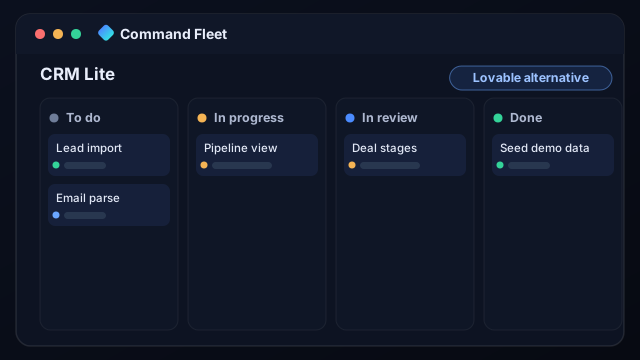
Lovable makes natural-language app building feel friendly. When you want to own the code outright, run several products at once, and pick your own AI agent, Command Fleet offers the same describe-it-and-build-it experience — on your machine.
Command Fleet is a local-first, agent-agnostic AI coding agent orchestrator. Where Lovable is best known as an AI app builder, Command Fleet runs Claude Code, Codex, and Gemini across a whole portfolio of projects — on a Kanban board, in isolated git worktrees, with a review gate and built-in deploys to six platforms. This guide is an honest, Lovable-versus-Command-Fleet comparison: what Lovable is genuinely great at, and the specific places a portfolio-scale, autonomous AI coding orchestrator goes further.
What Lovable does well
Lovable is approachable and produces polished UI from plain descriptions, which makes getting a good-looking app off the ground genuinely pleasant.
None of that goes away by choosing Command Fleet — and for hands-on work in a single project, Lovable may well stay open in another window. The point of this comparison runs the other direction: the specific capabilities you reach for once AI coding becomes a portfolio of projects to run rather than one file to edit.
When to consider a Lovable alternative
Lovable is fantastic for going from idea to a running app in minutes, which makes it a great place to start. You start weighing a Lovable alternative when you want to own the code outright, run it against your real git repositories on your own machine, add a review step before anything ships, and deploy wherever you like rather than only to a built-in host. Command Fleet keeps the one-sentence-to-app speed of an AI app builder but runs the whole build loop locally, on your own AI subscriptions, with your code on your disk.
Local-first by design
Command Fleet is local-first: your projects, data, and API keys never leave your machine, keys live in your operating system credential vault, and a per-project secrets vault is never included in any prompt. Your code — and your clients’ code — stays on your computer rather than uploaded to someone else’s servers, which turns confidentiality and NDAs into a one-sentence answer.
Local-first does not mean manual: an orchestrator on your own machine can plan a build, run agents in parallel, review, retry, and merge exactly like a cloud agent. And because everything is a git folder on disk, there is no lock-in — stop paying and you keep all of it.
Run a whole portfolio, not one project
Command Fleet organizes work as organizations → workspaces → projects → tasks, with each project on its own Kanban board and a home dashboard that rolls up what is running and what is waiting on review across everything. Whether you are a solo founder shipping seven side projects or an agency with a workspace per client, the entire portfolio of AI coding agents lives on a single screen instead of a dozen scattered browser tabs and terminal windows.
That portfolio layer is what most AI coding tools leave out. You can dispatch a feature to one project while a refactor runs in another and a dependency bump runs in a third, then clear them all from one cross-project review queue — the kind of parallel throughput that is impossible when you can only work one repository at a time.
Bring your own agents — Claude Code, Codex, Gemini
Command Fleet is agent-agnostic: dispatch any task to Claude Code, Codex, or Gemini — chosen per task, with an optional per-run model override — on your own AI subscriptions. You route the strongest model to a gnarly refactor and a cheaper, faster one to boilerplate and test scaffolding, optimizing each task instead of compromising across all of them.
Because it is bring-your-own, you pay the model providers directly and never a markup on every run, and you are never locked to a single vendor. If one agent gets stuck, re-dispatch the same task to another and compare the diffs — a fresh perspective often breaks the logjam.
Preview and deploy to six platforms, built in
Ship to Firebase, Vercel, Netlify, Cloudflare, Supabase, or Fly from the same app, with preview and deploy sharing one manifest so what you preview is exactly what goes live. Credential-gated deploys never fire with a missing secret, and a deploy you can reproduce is a deploy you can roll back.
Because the whole pipeline — scaffold, build, review, deploy — lives in one place, you go from prompt to production without stitching together separate tools for each stage. That end-to-end coverage is the part most AI coding tools stop short of.
Running a portfolio of AI coding agents
Most AI coding tools, Lovable included, are organized around one thing at a time — one file, one repo, one chat, one task. Command Fleet is organized around many. Each project gets its own Kanban board with To do, In progress, In review, and Done columns; a home dashboard rolls up how many workspaces, projects, and tasks you have, which AI agents are connected, your tasks-by-status, and what is waiting on review across the entire portfolio. You can even fan a single task out to two different agents, compare the diffs, and merge the better one. For anyone running more than one product, that portfolio view is the difference between feeling on top of the work and drowning in browser tabs — and it is the layer an editor or a single-task agent simply does not have.
Switching from Lovable to Command Fleet
- Install Command Fleet and create a workspace — one per client or product line works well.
- Add your projects by pointing Command Fleet at the same local git folders you already use, and set a setup script (such as
pnpm install) so fresh worktrees build cleanly. - Connect your agents — your Claude Code, Codex, and Gemini subscriptions — then dispatch a first small task to see the in-app diff, the verify gate, and the one-click merge in action.
Because your projects are just git repositories on disk, there is nothing to export and nothing locked in: moving from Lovable is mostly a matter of opening the folders you already have and pressing Run.
Command Fleet vs Lovable at a glance
| Capability | Command Fleet | Lovable |
|---|---|---|
| Describe to build | Build loop | Yes |
| Own your code & data | Local-first | Hosted |
| Many products at once | Workspaces | Per project |
| Pick your agent | Claude · Codex · Gemini | Built-in |
| Isolated git worktrees per task | Yes | Varies |
| Cross-project review queue | Yes | Varies |
| Free 7-day trial, bring your own model | Yes | Varies |
Who Command Fleet is for
Command Fleet tends to win over the same people who try Lovable and then realize they have outgrown working one project at a time: solo founders shipping a portfolio of apps who need real parallelism without losing the thread; agencies and freelancers who run a workspace per client and have to keep each client’s code confidential and cleanly separated; indie hackers who want an autonomous build loop on their own Claude, Codex, or Gemini subscriptions with no markup; and small teams who want isolated git worktrees, a review gate, and built-in deploys without standing up their own infrastructure. If any of those describe you, Command Fleet is well worth a look as a Lovable alternative.
Frequently asked questions
Is Command Fleet a Lovable alternative?
Yes. Command Fleet is a local-first, agent-agnostic orchestrator: it runs coding agents across a whole portfolio on a board, in isolated git worktrees, with review and built-in deploys. It is a strong Lovable alternative when you want to run many projects and choose your own model.
What is the difference between Command Fleet and Lovable?
Lovable is approachable and produces polished UI from plain descriptions, which makes getting a good-looking app off the ground genuinely pleasant. Command Fleet adds a portfolio board, your choice of Claude Code, Codex or Gemini per task, an autonomous build loop, isolated runs with a review gate, and deploys to six platforms — all local-first.
Can I use my own AI subscription with Command Fleet?
Yes — Command Fleet is bring-your-own. Connect your Claude, Codex, and Gemini subscriptions, choose the agent per task with an optional model override, and pay the providers directly with no markup on model usage.
Do I keep everything if I stop using Command Fleet?
Yes — your projects are git folders and your task history is a file on disk. There is no lock-in; cancel any time and you keep all of it.
Is Command Fleet free to try?
Yes — there is a free 7-day trial with no credit card. Because it is bring-your-own, you use your existing Claude, Codex, or Gemini subscriptions, so you are never double-charged for model usage.
Where does my code go when I use Command Fleet?
It stays on your machine. Command Fleet is local-first: projects, data, and API keys live on your computer, secrets are kept out of every prompt, and only the agent CLI you choose talks to its provider — there is no third-party server holding your repository.
If Lovable is where you started, Command Fleet is where you go when AI coding becomes a fleet to run, not a file to edit.
The Lovable alternative, on your machine
Command Fleet is portfolio-scale, agent-agnostic, autonomous, and 100% local. Free for 7 days, no credit card.