A branching strategy that works fine for two humans can fall apart when you have five agents committing at once. The fix isn't a more elaborate model — it's a simpler, stricter one. Here's a branching strategy designed for a fleet of agents working in parallel.
Why strategy matters more with agents
Agents work fast and in parallel, so any weakness in your branching model gets hit harder and more often. Long-lived branches drift further; ambiguous ownership causes more collisions. A strict, simple strategy turns that speed from a risk into an advantage.
One branch per task
The foundation: every task gets its own branch off main, in its own git worktree. No two agents share a working tree, so they can't clobber each other, and any task can be thrown away by deleting its branch. This is trunk-based development taken to its natural, agent-friendly conclusion.
Merge in dependency order
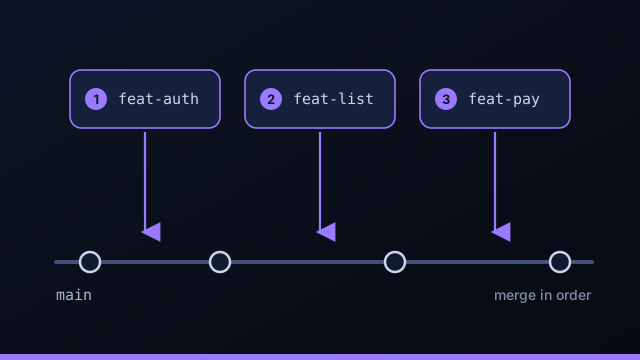
Finished branches don't merge in a free-for-all — they line up in a queue and integrate in dependency order. A passing branch lands before the tasks that depend on it start, so each builds on integrated work rather than a stale snapshot. The queue is what keeps parallel work coherent.
Parallel branches need a serial merge. A queue that integrates in dependency order is how you get both speed and a clean history.
Keep main releasable
Main should always be shippable. Enforce it mechanically: every merge passes a verify gate, and any conflict routes to review instead of being forced through. Main only advances through green, ordered integrations, so "is main releasable?" is always yes.
Keep branches short-lived
The best defense against conflicts is time. A branch that lives an hour drifts less than one that lives a week. Scope tasks small enough that a branch is created, reviewed, merged, and deleted in a single cycle — short-lived branches are conflict-resistant by nature.
For a fleet of agents, the right branching strategy is the boring one: one task, one short branch, merged in order.
Branch naming and hygiene for agents
When agents create branches, a little naming discipline keeps the repo legible. A simple convention — task/<short-slug>, like task/coupon-field or task/fix-mobile-nav — makes it obvious at a glance what each branch is for, and ties cleanly to the task it came from. Keep one task per branch so a branch maps to a reviewable unit of work, and avoid long-lived "kitchen sink" branches that accumulate unrelated changes. Because each branch lives in its own git worktree, you can have many open at once without confusion, as long as the names tell you what they are. Good hygiene here pays off at review time: a tidy list of well-named, single-purpose branches is far easier to reason about than a pile of agent-run-7.
Protecting main with many agents running
With a fleet of agents committing in parallel, your main branch needs guardrails so it stays releasable at all times. Enforce three rules mechanically. First, nothing merges without a verify gate — main only advances through changes that build and pass tests. Second, merge in dependency order through a queue, so each task integrates on top of finished work rather than a stale snapshot, which is what keeps the history coherent. Third, route conflicts to review instead of force-merging them. Together these mean "is main shippable?" is always yes, no matter how many AI coding agents are working at once. The whole point of branch-per-task isolation is that the chaos stays on the branches and never reaches main.
Cleaning up after parallel runs
Parallel agents generate a lot of branches and worktrees, and stale ones accumulate fast if you don't prune. The rule is simple: a branch and its worktree are disposable, so remove them the moment the task merges or is discarded. A merged task's branch can be deleted immediately; a discarded run's branch and worktree should be torn down so they don't clutter git worktree list. Doing this by hand across a dozen worktrees and several projects is exactly the bookkeeping you'd rather automate — which is where an orchestrator helps. Command Fleet creates a worktree per task, merges in dependency order, and cleans up automatically when a task is done, so the branching strategy stays tidy without you policing it.
The branching strategy in one paragraph
For a fleet of AI coding agents, the right git branching strategy is the boring, strict one: one short-lived branch per task, off main, in its own git worktree; merge each finished branch back through a queue in dependency order once it passes a verify gate; keep main releasable at all times by never merging a red build and routing conflicts to review instead of forcing them; and clean up branches and worktrees the moment a task merges or is discarded. That's trunk-based development taken to its agent-friendly conclusion — isolation keeps the chaos on the branches, ordering keeps the history coherent, and short lifetimes keep conflicts rare. You can run this by hand, but the bookkeeping across dozens of worktrees and several projects is exactly what an orchestrator like Command Fleet automates, so the strategy stays tidy without you policing every branch.
Frequently asked questions
What git branching strategy works for AI agents?
A simple trunk-based model: one short-lived branch per task off main, merged back in dependency order through a merge queue once it passes its verify gate. It keeps a fleet of agents from stepping on each other while keeping main releasable.
Should each agent task get its own branch?
Yes. One branch (and worktree) per task is what makes parallel runs safe — agents never share a working tree, and a bad task is discarded by deleting its branch with nothing else affected.
How do you keep main stable with many agents?
Gate every merge on a verify gate, integrate in dependency order so each task builds on finished work, and route any conflict to review instead of forcing it. Main only ever advances through green, ordered merges.
How long should agent branches live?
As briefly as possible. Short-lived branches drift less from main and conflict less. Scope tasks small so a branch is created, merged, and deleted in one cycle rather than lingering for days.
One task, one branch, merged in order
Command Fleet gives every task its own worktree and merges through a dependency-ordered queue. Free for 7 days, no credit card.