The appeal of an autonomous AI engineer is obvious: describe the work, walk away, come back to a pull request. The hesitation is just as obvious — handing a hosted black box your source code, your keys, and a bill with a markup on every run. The good news is you can keep the autonomy and drop the trade-offs.
What people actually want from Devin
Strip away the branding and the wish list is short: autonomy (plan, build, test, fix without hand-holding), reliability (it doesn't spin forever or quietly break things), and a result you can review. None of that requires a hosted black box — those are properties of a well-designed loop, not of where the loop runs.
The case for local and agent-agnostic
Two choices change the economics and the risk profile. Local-first keeps your code, data, and keys on your machine — a much easier answer to "where does our code go?" Agent-agnostic lets you bring your own Claude, Codex, or Gemini subscription and pick per task, so you're not married to one model or paying a reseller's markup on every token.
Autonomy is a property of the loop, not the cloud. You can have plan-build-review-merge entirely on your own machine.
How a local orchestrator compares
Command Fleet runs the full autonomous loop — scaffold from a stack pack, plan a dependency-aware task graph, execute tasks in parallel worktrees, retry failures, and merge — and then stops at a review gate so a human approves what ships. It's the same fire-and-forget experience, with your code never leaving home and your own subscriptions doing the work.
Side by side
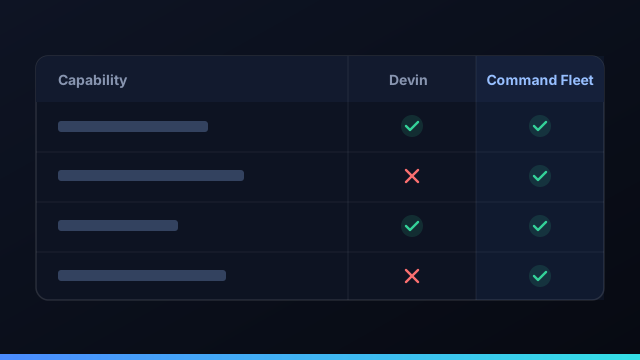
| Capability | Command Fleet | Hosted autonomous agent |
|---|---|---|
| Autonomous plan → build → review | Yes | Yes |
| Runs locally, code stays on your machine | Yes | Hosted |
| Bring your own model | Claude · Codex · Gemini | Bundled |
| Per-run markup | None | Often |
| Portfolio of projects | Yes | Varies |
Getting started
Because your projects are just git repositories, switching is low-risk: install Command Fleet, create a workspace, point it at your existing folders, and dispatch a first task. You keep the autonomy, gain a portfolio view, and your code stays on your disk.
You don't have to choose between "autonomous" and "in your control." A local orchestrator gives you both.
Autonomy without the black box, in detail
The appeal of an autonomous AI engineer is real, but so is the hesitation about handing a hosted black box your source, your keys, and a bill with a markup on every run. The good news is that autonomy is a property of the loop, not of where it runs. A local orchestrator runs the same plan-build-review-merge cycle on your own machine: it scaffolds from a stack pack, decomposes the work into a dependency-aware task graph, runs the ready tasks in parallel across isolated git worktrees, retries failures, merges in order, and can deploy. You see exactly what it did — every diff, every branch, the full history — and you stay the reviewer at every gate. It's the same fire-and-forget experience as a hosted agent, with none of the opacity and none of your code leaving home.
The economics of bring-your-own
Cost is where a local, agent-agnostic Devin alternative quietly wins. A hosted autonomous agent that bundles model usage into its price is charging you the provider's cost plus a margin on every single run — and locking you to whatever model it ships. Bring-your-own flips that: you connect your existing Claude, Codex, and Gemini subscriptions, pay the providers directly with no resale markup, and route the strongest model to the hard problems and a cheaper one to boilerplate. Over a month of real use, removing that per-run margin and matching model to task is the difference between a predictable bill and one that creeps. You're never double-charged for the same tokens, and you're never stuck with one vendor's model when another would do the job better.
Getting started with a local Devin alternative
Because your projects are just git repositories, switching is low-risk. Install Command Fleet, create a workspace (one per client or product line works well), point it at your existing git folders, and connect your AI subscriptions. Dispatch a first task — a bug fix or a small feature — and watch the autonomous loop plan, run, and review it, with the result landing in your queue as an in-app diff. From there you can hand it larger, multi-step builds and let it scaffold, plan a task graph, and deploy. You keep the autonomy of a hosted engineer, gain a portfolio board across all your projects, and your code stays on your disk the entire time.
What to look for in a Devin alternative
If you're evaluating autonomous AI engineers, weigh each option against the things that actually matter for real work:
- Autonomy that recovers — plans a task graph, retries failures, and surfaces what it can't resolve, rather than spinning or silently shipping.
- Local-first execution — your code and keys stay on your machine, not on a hosted black box.
- Your choice of model — Claude Code, Codex, or Gemini per task, on your own subscriptions, with no per-run markup.
- Isolation and review — every run in its own git worktree, with an in-app diff and a verify gate before merge.
- Portfolio scale — many projects on one board, not a single task at a time.
- Built-in deploy — from scaffold to a live URL without bolting on separate tools.
A hosted agent may tick the first box; a local, agent-agnostic orchestrator like Command Fleet is built to tick all six. That combination — autonomy without the black box — is what most people are really after when they search for a Devin alternative.
Frequently asked questions
What is a good Devin alternative?
Look for the same autonomy — plan, build, test, iterate — without the black box: local execution so your code stays on your machine, your choice of agent and model, isolated git worktrees, and a review-before-merge gate. Command Fleet is built around exactly that.
Is there a local alternative to Devin?
Yes. A local-first orchestrator runs the whole plan-build-review loop on your own machine, with keys in your OS vault and code that never leaves your computer, while still offering autonomous multi-step builds.
Can I use my own models instead of a bundled one?
With an agent-agnostic tool, yes. You bring your own Claude, Codex, or Gemini subscription and choose per task, so you're not locked to one vendor or paying a markup on every run.
Do I give up autonomy by going local?
No. A local orchestrator can scaffold, plan a task graph, run agents in parallel, retry failures, and merge — the same fire-and-forget loop — with the one trade-off that your machine has to be on to run.
Autonomy without the black box
Command Fleet runs the full plan-build-review loop locally, on your own model subscriptions. Free for 7 days, no credit card.